
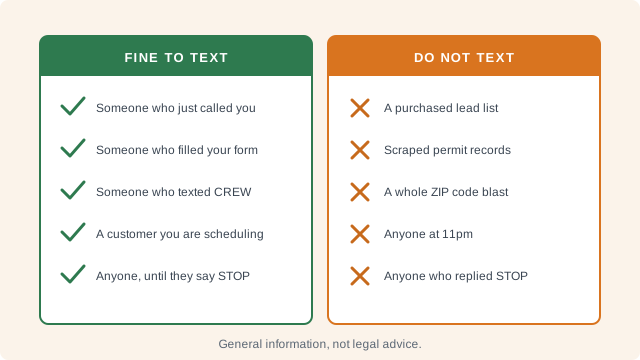
“Can I contact my old customers about spring work?” Usually yes, by a live phone call, if the last job was recent enough and they have not asked you to stop. That is the do-not-call rules’ “established business relationship” exception. It is narrower than it sounds: it has a clock, it ends the moment a customer says “don’t call me,” and it does nothing for robocalls or autodialed marketing texts. Here is how it works and a routine that keeps you inside it.
What the do-not-call rules forbid
Two federal rules cover sales calls to homes. The FTC’s Telemarketing Sales Rule bars an outbound telemarketing call to a number on the National Do Not Call Registry, and to anyone who has told that seller not to call (16 CFR §310.4(b)(1)(iii)). It applies to campaigns involving more than one interstate call. The FCC’s rule bars a telephone solicitation to a residential subscriber on the registry (47 CFR §64.1200(c)(2)), and the FTC notes that the registry covers intrastate calls under the FCC’s rules. The FCC applies these rules to telemarketing texts to cell phones as well (§64.1200(e)).
It is easy to assume you are outside all this because the sale closes at the kitchen table. The Telemarketing Sales Rule does exempt calls where the sale is not completed, and no payment is required, until a face-to-face presentation, but that exemption expressly does not apply to the do-not-call and calling-hours provisions (§310.6(b)(3)). The FTC’s guide says the same: such callers still must not call numbers on the registry or the seller’s own do-not-call list, or call outside the permitted hours.
The exception, and its two clocks
Both rules let you call a registered number if you have an established business relationship with the person and they have not asked you to stop. The relationship comes from one of two things:
Say a fence company finished a job and took the final payment on March 20, 2025. The FTC’s 540 days run out on September 11, 2026; the FCC’s 18 months on September 20. Use the earlier date. A homeowner who asked for an estimate on January 12, 2026 and never booked could be called about it until about April 12, 2026. After that, the company needs the person’s written agreement to be called, or a new transaction, before it calls a number on the registry.
Three limits come with the exception:
Your own do-not-call list
Any business making telemarketing calls to homes must keep its own do-not-call list, under §64.1200(d): a written policy available on demand, training for whoever makes the calls, and a record of each request at the time it is made. A request must be honored within a reasonable time of no more than ten business days, and for five years. The caller must give his own name, the business’s name, and a phone number or address where the business can be reached.
Why it does not cover robocalls or autodialed texts
The established business relationship is an exception to the do-not-call rules and nothing else. A separate rule covers how the call is made. A call or text that advertises or is telemarketing, made with an autodialer or an artificial or prerecorded voice to a cell phone, needs the recipient’s prior express written consent (§64.1200(a)(2)). A prerecorded telemarketing message to a home line needs it too (§64.1200(a)(3)). Neither rule has an exception for past customers. The Telemarketing Sales Rule likewise allows a prerecorded sales call only with the person’s express written agreement (16 CFR §310.4(b)(1)(v)).
Texts are where this gets narrow. Since Facebook v. Duguid (2021), a federal “autodialer” is equipment with the capacity to store or produce numbers using a random or sequential number generator, so a hand-typed text to a past customer inside the window may fall under the relationship exception like a call does. Do not build a marketing program on that. Whether a particular texting tool counts is a legal question, several states use broader wording (see state texting laws stricter than the TCPA), and Washington allows a commercial text only if the customer “has clearly and affirmatively consented in advance,” whatever your history with them (RCW 19.190.070). For marketing texts, get written consent.
Marketing or informational
All of the above is about sales messages. The FCC defines telemarketing as a call or message “for the purpose of encouraging the purchase or rental of, or investment in, property, goods, or services,” and an advertisement as material “advertising the commercial availability or quality” of goods or services (§64.1200(f)(1) and (f)(13)). By those definitions:
A message that mixes the two is safest treated as marketing. Keep reminders and offers in separate messages.
States have their own lists and exceptions
State law can differ in either direction. Florida keeps its own “no sales solicitation calls” list (Fla. Stat. §501.059), and Florida, Oklahoma and Maryland end sales calls at 8 p.m. and cap attempts on one subject (Fla. Stat. §501.616; Okla. Stat. tit. 15, §775C.4; Md. Code, Com. Law §14-4502); State Texting Laws Stricter Than the TCPA sets out those laws and their own business-relationship exemptions. Check the law of the state where the customer is, and use the strictest hours that apply.
A past-customer call routine
- Export your customer list with each person’s last payment date and each prospect’s last inquiry date, and work out when each window closes. Use the shorter federal count.
- Remove everyone who has ever asked not to be contacted. Set aside anyone whose window has closed, and check those numbers against the National Do Not Call Registry before calling any of them: the FTC says sellers must update their copy of the registry at least every 31 days, that data for up to five area codes is free, and that from October 1, 2026 each further area code costs $85 a year, up to $23,425.
- Make live calls from your business number, between 8 a.m. and 8 p.m. in the customer’s time zone, which also meets the earlier state hours.
- Write down every “don’t call me” on the spot, add it to your list, and keep it for five years.
- For texts and recorded messages, ask for written consent at the job: a checkbox on the contract that names your business and the number and says agreeing is not a condition of the work.
The stakes are real. A person who gets more than one call within 12 months by or for the same business in violation of the do-not-call rules may sue for actual loss or up to $500 per violation, whichever is greater, and a court may triple the award if the violation was willful or knowing (47 U.S.C. §227(c)(5)). The same subsection gives a defense to a business that has established and implemented, with due care, reasonable practices to prevent such calls, which is one more reason to write your routine down. TCPA in Plain English and Texting customers in 2026 cover the consent and opt-out rules for texting.
General information, not legal or tax advice. Rules change and vary by state; check with the agency named above or a professional for your situation.