
“Are there state rules for texting customers too?” Yes, and in some states they are stricter than the federal ones. The Telephone Consumer Protection Act and the FCC’s rules are a floor. Florida, Oklahoma and Maryland have passed state versions with earlier quiet hours, a cap on attempts, their own consent wording and their own lawsuits. Texas pulled text messages into its telephone solicitation law in 2025, and Washington has had a law on commercial texts since 2003. Here is what each one says about sales texts, and one way of working that fits all of them.
This is about texts that sell. A reply to someone who just asked you for a quote, or a reminder of tomorrow’s appointment, is a different thing; TCPA in Plain English draws that line, and Texting customers in 2026 covers the federal consent and opt-out changes.
The federal floor
Under the FCC’s rules, a telephone solicitation may go to a residential subscriber only between 8 a.m. and 9 p.m. at the called party’s location, never to a number on the national do-not-call registry without an exception, and those rules apply to telemarketing texts to cell phones too (47 CFR §64.1200(c) and (e)). A marketing text sent with an autodialer needs the recipient’s prior express written consent (§64.1200(a)(2)). The recipient of an unlawful one may sue for $500 per violation or actual loss, and a court may triple it for a willful or knowing violation (47 U.S.C. §227(b)(3)).
One point matters for what follows. In Facebook v. Duguid (2021), the Supreme Court held that a federal “autodialer” must have the capacity to store or produce numbers using a random or sequential number generator. The Oklahoma and Maryland laws below use their own words, “an automated system for the selection or dialing of telephone numbers” (Florida’s says “selection and dialing”), and Washington’s text law has no equipment test at all, so do not assume that a tool which is not a federal autodialer falls outside them.
Florida, Oklahoma and Maryland
These three laws read alike, and each is stricter than the federal floor in the same three ways:
| Florida | Oklahoma | Maryland | |
|---|---|---|---|
| Law | Stat. §501.059 and §501.616 | tit. 15 §775C.1 and after (Nov. 1, 2022) | Com. Law §14-4501 and after (Jan. 1, 2024) |
| Quiet hours | No sales calls before 8 a.m. or after 8 p.m. | No sales calls before 8 a.m. or after 8 p.m. | None between 8 p.m. and 8 a.m. |
| Attempts | No more than 3 in 24 hours on the same subject | No more than 3 in 24 hours on the same subject | No more than 3 in 24 hours on the same subject |
| Automated sales calls and texts | Need prior express written consent | Need prior express written consent | Need prior express written consent |
| Private suit | $500 or actual damages, up to triple (§501.059) | $500 or actual damages, up to triple | Up to $500 or actual damages, up to triple |
Consent. All three define prior express written consent much as the FCC does: a signed written agreement that clearly authorizes sales calls or texts by automated means to a stated number, with a clear and conspicuous disclosure that the customer does not have to agree in order to buy anything. Florida’s definition of a signature includes “checking a box indicating consent or responding affirmatively to receiving text messages.”
Area codes. Each state presumes that a call to one of its area codes reaches someone in the state. A customer who moved away but kept a Florida number may still be treated as a Floridian unless you can show otherwise.
Caller ID. Each requires the originating number to be transmitted, and Florida and Oklahoma add that the number shown must be able to take calls and connect the caller back to you or to the seller.
The exemptions differ, so read your own state’s. Florida’s autodialer rule covers “unsolicited” sales calls, and the statute says that a call made at the person’s express request, about an unfinished contract, or to someone with a “prior or existing business relationship” is not unsolicited; it does not say how long that relationship lasts. Florida’s hour and attempt limits sit in its Telemarketing Act, which exempts several kinds of seller but keeps those two limits for them anyway. Maryland’s consent rule does not apply to, among others, a single solicitation answering the customer’s own inquiry, or someone soliciting maintenance or repair of goods previously bought from them, but its quiet hours and attempt limit apply to every telephone solicitation. Oklahoma exempts from its whole act, among others, a seller who makes the main sales presentation and closes the sale at a later face-to-face meeting, maintenance or repair of goods previously bought from the seller, and solicitations to existing or past customers.
Florida’s STOP step. Before suing over text solicitations, a Florida recipient must first reply “STOP.” The business then has 15 days to stop texting, and may send one text confirming it got the notice.
Note the wording. Florida’s and Oklahoma’s hour limits speak of phone calls, while their consent rules expressly name text messages, and Maryland’s consent definition names text messages too. Treating texts as covered by every rule here is the safe reading.
Texas after SB 140
Since September 1, 2025, Texas defines a “telephone solicitation” under Chapter 302 of its Business and Commerce Code as a call “or other transmission, including a transmission of a text or graphic message or of an image,” made to induce a purchase. The same bill made a violation of two neighboring chapters, 304 (on telemarketing) and 305, a deceptive trade practice, enforceable by public or private remedies.
Chapter 302 is a registration law: unless exempt, a seller files with the Secretary of State, with a $200 filing fee and a $10,000 security. Citing a 2025 federal case, Ecommerce Marketers Alliance v. Texas, and an agreement among its parties, the Secretary of State has posted a notice that “any business that sends text messages with prior consent of the consumer is not required to complete the Telephone Solicitation Registration Statement.” Consent, again, is what keeps you out of it.
Washington’s commercial text law
Washington goes further in one respect. RCW 19.190.060 bars anyone doing business in the state from sending a commercial text message, one sent to promote goods or services, to a Washington resident’s cell phone. The exception that matters to a contractor is that the subscriber “has clearly and affirmatively consented in advance” (RCW 19.190.070). There is no autodialer element and no business-relationship exception in that section. A violation is also a Consumer Protection Act violation, and a 2026 amendment set the recipient’s damages at $100 or actual damages, whichever is greater, for suits started on or after June 11, 2026.
One way of texting that fits all of them
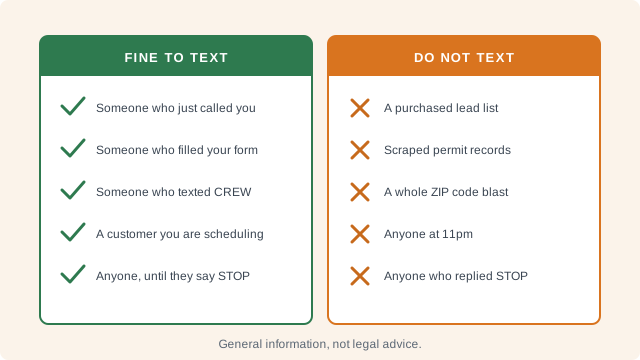
You do not need fifty playbooks. Run your sales texts to the strictest version of each rule above and one routine covers the rules this article describes:
Say a Maryland gutter company plans a spring promotion to past customers and schedules it for 8:30 on a weeknight. Under the federal rule that is inside the window, which runs to 9 p.m. Under Maryland’s law it is half an hour late. Moving the send to 10 a.m. costs nothing and takes the question off the table, and a customer list built with written consent takes care of the rest.
Carrier registration for business texts from local numbers is a separate matter from all of these laws; A2P 10DLC registration covers it.
General information, not legal or tax advice. Rules change and vary by state; check with the agency named above or a professional for your situation.