
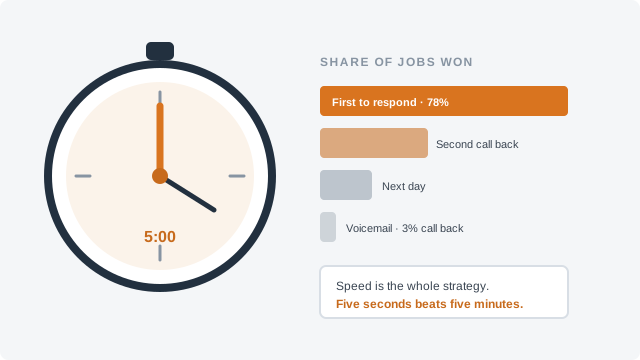
A homeowner fills in your web form at lunch. You call her back at three o’clock from the truck, and her screen shows your number with a warning above it. She lets it ring. To her you are one more robocall; to you she is a lead that never picked up. Getting back to people fast, the subject of The Five-Minute Rule, does nothing if the call arrives wearing a label.
Nobody at the phone company looked at your business and decided you were a scammer. The label comes from software that scores calls, and the software reads things you can change. Here is who applies it, what the federal rules require of the carriers, and what to do about a wrong one.
Who puts the label there
Each carrier uses its own words. T-Mobile’s support page says its Scam ID feature “automatically displays ‘Scam Likely’” on suspected scam calls, and that customers will also see some calls labeled as Telemarketing, Political or Potential Spam. Verizon’s feedback site lists its labels as Potential Spam, Potential Fraud, Robo caller and SPAM?, and says that a call labeled differently, “e.g. SPAM LIKELY,” was not labeled by Verizon; the person should check with their spam protection service provider. So the warning your customer describes may come from her carrier or from a call-blocking app on her phone.
Analytics companies are part of the picture. The Free Caller Registry, a free sign-up for business numbers, is run by three of them, First Orion, Hiya and TNS, which it calls call protection providers. Verizon’s form tells businesses their feedback “will be shared with our third party spam analytics provider.”
Federal rules allow the filtering. Under 47 CFR §64.1200(k)(3), the customer’s phone company may block a call without liability when, among other conditions, the blocking is “based on the use of reasonable analytics designed to identify unwanted calls,” the analytics consider caller ID authentication information where it is available, the customer can opt out, and the caller gets the free redress the rule requires (more on that below).
What STIR/SHAKEN does, and what it does not
STIR/SHAKEN is the caller ID authentication framework the FCC requires. In the FCC’s words, calls traveling through IP phone networks “can have their caller ID ‘signed’ as legitimate by originating carriers and validated by other carriers before reaching consumers,” so the receiving phone company can verify that a call really comes from the number on the screen. The rule, 47 CFR §64.6301, required voice service providers to put it in their IP networks by June 30, 2021, and the FCC has since extended the duty to more kinds of providers.
Two limits matter to you:
The calling habits that read as spam
Verizon publishes best practices for legitimate callers on its feedback site. Read with a small contracting business in mind, these are the ones that matter:
The same list advises against using one number for several purposes, giving marketing, surveys and support callbacks as the example. The number your customers know is for calling back people who asked to hear from you.
Hiya, one of the three registry companies, describes the same signals in its guide for businesses: “High volumes of calls to a wide array of unrelated numbers, especially if done in a short time frame, can signal invasive or aggressive behavior,” and “A pattern of negative responses, such as call blocking or spam reporting, can lead to future calls from that caller being labeled as spam or nuisance.”
Now put that into a contractor’s week. Say an owner saves up a weekend of web leads and returns twenty of them back to back on Monday morning, from a calling-app number none of those people has seen, hanging up whenever voicemail picks up. Nearly every item above points the wrong way: a burst of volume, an unfamiliar number, short unanswered calls. The same twenty calls spread through the day, from the number printed on the truck and the website, look like what they are. And calling a bought list of strangers is exactly the “wide array of unrelated numbers” Hiya describes, with legal risk of its own; see the TCPA in plain English.
Five steps for this week
- Return calls from the number they called. Use one number for your website, your Google profile, your truck and your callbacks. A customer who sees the number she dialed an hour ago knows who is calling, and the number builds a steady history instead of a fresh one each time.
- Check the name that goes out with your calls. Ask your phone provider what caller name is sent with calls from your business line, and have it match the business name on your website and invoices.
- Register your numbers. The Free Caller Registry form asks for your business details, a contact person with a verified email, your calling habits (purpose and volume), and your numbers: up to 20 typed in, or a file for more. It is free and goes to all three providers at once; each sends its own acknowledgment. Two conditions: you must be the business that makes the calls, not a vendor registering for someone else, and the site says plainly that registration “does not guarantee redress” because each provider does its own analysis.
- Test from the other side. Ask a friend or relative on each major carrier to let you call them, and to tell you exactly what their screen shows. Do it again a few weeks after you register.
- Count your connected callbacks. The one-week log in Your Answer Rate can carry one more column: for every lead you call back, did a person pick up? Compare a week before the changes with a week after.
When a wrong label is already there
Go to the carrier whose customers see it:
The federal rule is firmest about blocking. Under §64.1200(k)(8), a terminating provider that blocks calls, or uses caller ID authentication information in deciding how to deliver them, must keep a single point of contact on its public website for blocking error complaints. It must resolve disputes about caller ID authentication within a reasonable time, with a status update within 24 hours at the least; when a credible claim shows calls should not have been blocked, or the delivery decision was not appropriate, it must promptly stop that treatment for the number unless circumstances change; and it may not charge a caller for a complaint made in good faith. If your calls are not ringing through at all, that is the complaint to file.
Branded calling, and whether you need it
CTIA, the association that represents the U.S. wireless industry, runs Branded Calling ID, which shows a verified caller’s name, logo and call reason on the customer’s screen. Its site says enterprises’ numbers, display names, logos and call reasons “are thoroughly vetted by Authorized Partners,” and that “enterprises only pay when Branded Calling ID confirms their information was delivered.” CTIA announced on September 15, 2025 that it had signed a contract with Verizon to bring it to Verizon’s network. It is a paid service, delivered through those partners and built on STIR/SHAKEN. For a shop making a few dozen callbacks a week, the free steps above come first; branded calling is worth pricing only if your calls stay labeled after them.
None of this replaces the first rule of callbacks: be quick, call from a number the customer knows, and leave a short voicemail with your business name and the job she asked about, so that even an unanswered call tells her who you are.