
“Is it legal for customers to sign my estimate online?” Yes. A signature typed into a form or drawn with a finger on a phone screen is not worth less than ink because it is electronic, under federal law and under the state laws modeled on the same idea. The trouble spots are elsewhere: what the estimate actually says, the notices some laws want delivered in writing, and the kitchen-table sales where the law was written for paper. Here is each one, and how to get a quicker yes without walking into them.
What federal law says about e-signatures
The Electronic Signatures in Global and National Commerce Act, usually called E-SIGN, covers transactions in or affecting interstate commerce. It says a signature, contract or other record relating to such a transaction “may not be denied legal effect, validity, or enforceability solely because it is in electronic form,” and that a contract may not be denied effect solely because an electronic signature or record was used to form it (15 U.S.C. §7001(a)).
The act defines an electronic signature broadly: “an electronic sound, symbol, or process, attached to or logically associated with a contract or other record and executed or adopted by a person with the intent to sign the record” (§7006(5)). By that definition the form of the mark matters less than the intent behind it. A typed name in a box marked “Sign here to accept” is built to show intent; a thumbs-up emoji in a text thread leaves room to argue about what was meant.
Two limits sit in the same section. E-SIGN does not change any other legal requirement except the one that a contract be written, signed or on paper (§7001(b)(1)). And it does not require anyone to agree to use or accept electronic records or signatures (§7001(b)(2)). A customer who wants a paper contract can have one.
What the state law adds: UETA
The Uniform Law Commission approved the Uniform Electronic Transactions Act in 1999 and recommended it for enactment in all the states. California’s version, for one, is Civil Code §1633.1 and the sections after it. States adjust the model when they adopt it, so read your own state’s text; the section numbers below are the model act’s.
Binding to what? The document decides
Section 9’s second half is the honest answer to “are they binding.” The signature is no weaker for being electronic, but what it commits anyone to comes from the page it sits on. If you want a signed estimate to mean “yes, do this work at this price,” write the page that way:
A page headed “estimate only, not a contract” with a signature box at the bottom says two different things. Pick one.
Then make sure both of you keep it. Where a law requires the contract to be in writing, E-SIGN lets its electronic version be denied effect if it is not in a form that can be “retained and accurately reproduced for later reference by all parties” (§7001(e)). Email the customer a PDF of the signed version the moment it is signed, and keep your own with the date, the time and the email address the link went to.
The consent step for notices the law wants in writing
One part of E-SIGN catches contractors who sell to homeowners. When a statute or regulation requires information to be given to a consumer in writing, an electronic record satisfies that requirement only if the consumer has affirmatively consented to it (§7001(c)(1)). A consumer is an individual buying for personal, family or household purposes (§7006(1)), which is every homeowner hiring you for their own house. Before consenting, the consumer must get a clear and conspicuous statement of:
- Any right to have the record on paper, and the right to withdraw consent, with any conditions, consequences or fees for withdrawing.
- Whether the consent covers only this transaction or identified kinds of records over the whole relationship.
- How to withdraw consent and how to update the email address.
- How to get a paper copy after consenting, and whether there is a fee.
- The hardware and software needed to open and keep the records.
The consumer must then consent, or confirm consent, electronically, “in a manner that reasonably demonstrates” that they can open the records in the form you will use (§7001(c)(1)(C)(ii)). In practice that is a short screen before the documents: the five points in plain words, a free paper copy on request, and a button that opens a sample PDF with “I can open this and I agree to receive this job’s contract and notices by email.” The step matters for the disclosures a statute requires, such as a state’s required contract notices; an estimate no law requires you to deliver does not need it.
Where the law still expects paper
The FTC’s Cooling-Off Rule. When a sale of $25 or more is made at the buyer’s home, with some exceptions, the seller must give a completed copy of the contract with a statement of the three-day right to cancel next to the buyer’s signature in at least 10-point bold type, a completed “Notice of Cancellation” form in duplicate, and an oral explanation of the right (16 CFR §429.0(a), §429.1(a), (b) and (e)). When the FTC amended the rule in 2015, it noted that the rule “does not expressly address electronic methods” of meeting the duplicate receipt and notice requirement, and that whether E-SIGN could provide them “would depend on a case-by-case analysis” (80 FR 1329, 1331). The same notice says the rule does not apply to sales conducted entirely by mail, phone or internet, but only “as long as there is not any other in person contact” before the work is performed. An estimate visit at the house is in-person contact. The 3-Day Right to Cancel explains when the rule covers your sale.
State home-solicitation laws. California is the clearest example. Its electronic transactions act “does not apply to any specific transaction described in” Civil Code §1689.6 or §1689.7, the home solicitation sales that carry a right to cancel (Civil Code §1633.3(c)). For most of those sales, §1689.7 asks for a Notice of Cancellation form “attached to the agreement or offer to purchase” that is “easily detachable,” words written for paper; home improvement contracts carry their own wording of the notice, set out in the same section and in Business and Professions Code §7159. The exclusion does not forbid doing such a deal electronically where another law allows it (§1633.3(f)), but it means the state’s e-signature statute does not do the work for you. California also requires a home improvement contract over $500 to be in writing and signed before work starts, and the contractor to give the buyer a copy signed and dated by both (Business and Professions Code §7159(b), (c)(3)(A) and (d)).
The practical rule: for a sale your state or the FTC treats as a home solicitation, bring the paper contract and the cancellation forms to the table, or check with a lawyer in your state before replacing them with a link. Use the link freely where those rules do not reach.
Getting a quicker yes from a link
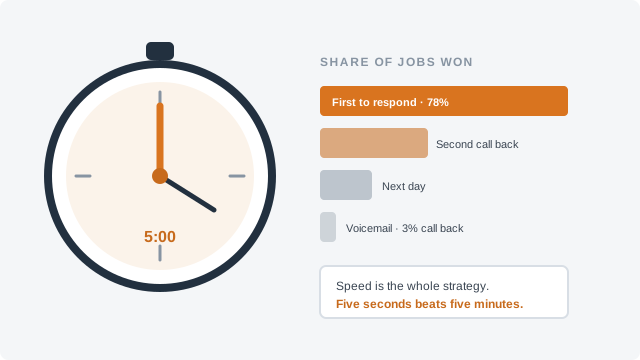
- Send it the same day as the visit, while the homeowner still remembers what you measured and why.
- Put a short summary at the top: the price, the start window and the three or four things that are included. The full terms follow below it.
- Ask for the signature on the whole document, not on a page that only shows the total.
- Send both of you the signed copy at once, as a file the customer can save and print.
- Offer paper in the same email for anyone who prefers it. The law gives them that choice anyway.
If you send estimates from the office in our tools, the customer opens a link, types their name and taps Accept, and the estimate (and its job, when it is tied to one) moves to accepted with the price on it. That acceptance is a yes to the price, not a signed contract, and the estimate page says so; where your state or the FTC wants a signed contract with notices, use one alongside it.
General information, not legal or tax advice. Rules change and vary by state; check with the agency named above or a professional for your situation.