Written for the person holding the nail gun

We build software for home-service contractors. Each article here answers one practical question about the business side of a trade. Every article published since 20 October 2026 is written from named public sources (government agencies, the laws and codes themselves, published studies, cost guides and companies’ own price pages), listed at its foot, and its facts are checked against those sources. Every number we cite either names where it comes from (the publisher, the year and a link) or says plainly that it is our own example or assumption. Competitor prices also say the month we checked them (“checked October 2026”), link to the competitor’s own price page, and are re-checked every three months; a price we cannot re-check comes off. Nothing here requires you to buy anything.


An example contractor website analytics view showing 214 visitors and only 3 form submissions, with a flat line of leads under tall bars of traffic
Websites

Is Your Contractor Website ADA Accessible? What the Law Requires

Website accessibility lawsuits are real, and the law behind them is less settled than the demand letters suggest. What the Justice Department says, where courts split, WCAG 2.2 as the yardstick, the fixes that matter on a small site, and why an overlay widget is not the fix.

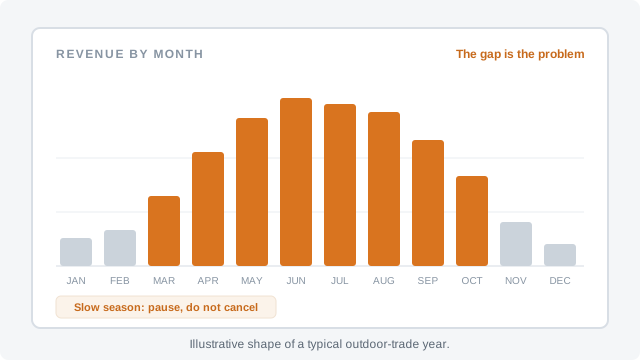
A twelve-month bar chart of contractor revenue with a tall summer peak and a deep winter trough
Business

Job Costing: Finding Out Which Jobs Make Money

Busy all the time and still short of money? Track hours, materials and subs against the price on every job, work out gross profit per crew hour by job type, and you find out which work pays for the business and which quietly eats it.

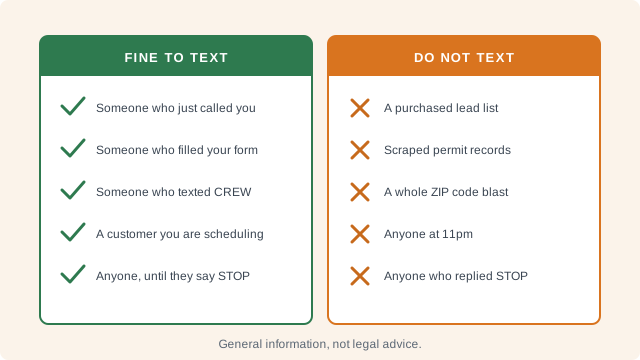
A two-column checklist of contractor texts that are fine to send and texts that are not
Compliance

OSHA at the Job Site: What to Do When an Inspector Arrives

An OSHA compliance officer just pulled up. What the rules say about credentials, warrants, the opening conference, the walkaround and employee interviews, then the 15 working days after a citation and the penalty reductions small employers can earn.

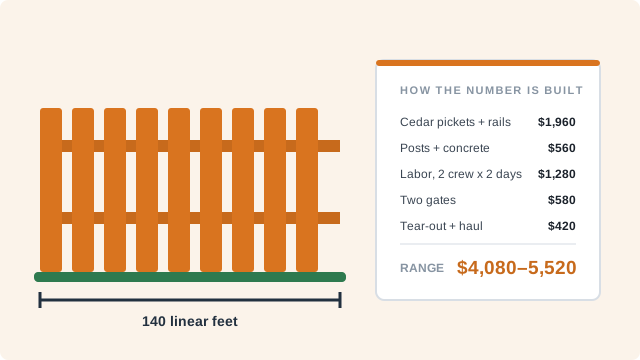
A 140-foot cedar fence line beside a price breakdown of material, posts, labor, gates and tear-out
Pricing

Pricing Concrete Flatwork: Yards, Thickness and Finish

A driveway or patio price is built from quantities you can measure before the pour: yards from area and thickness, the base, the tear-out, the finish, and the delivery extras that eat small jobs. The math, the published specs behind it, and a worked example.

A 140-foot cedar fence line beside a price breakdown of material, posts, labor, gates and tear-out
Pricing

Pricing Junk Removal by the Truckload

A truckload price works when it is built from three costs: the crew's time, the truck, and the landfill's fee by the ton. Measure your box in cubic yards, weigh a load with EPA's conversion factors, add item and stairs surcharges, then check it against a published range.

A 140-foot cedar fence line beside a price breakdown of material, posts, labor, gates and tear-out
Pricing

Pricing Tree Removal: Height, Diameter, Targets and Access

Two trees of the same height can be a morning's work or two days of rigging. The factors that set a removal price, how to build the number from your own crew and equipment costs, stump grinding as its own line, and why the homeowner should hear a range first.

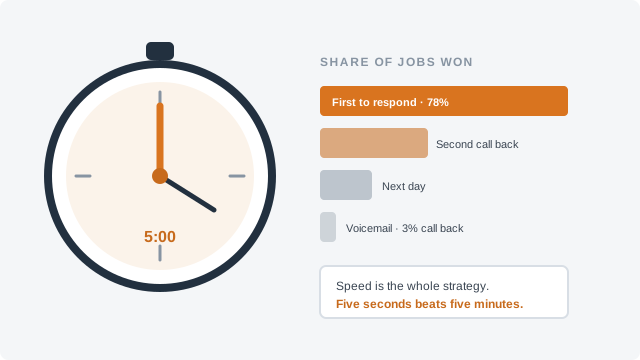
A stopwatch stopped at five minutes beside three things that can happen to a call: you answer, it goes to voicemail, or nobody picks up and the caller rings the next name
Lead Response

The First Sixty Seconds of a Lead Call

Answering is half of it. A one-minute structure for a new customer's call: who you are, who they are and how to reach them, what and where, how soon, then a price range or the next step and a booked time, plus the questions that save a wasted trip.

A twelve-month bar chart of contractor revenue with a tall summer peak and a deep winter trough
Business

The Owner's Pay: How Much to Pay Yourself and How

How the money reaches you depends on your business structure; how much should depend on your hours, not your bank balance. Price your own labor into jobs as a wage, keep profit as its own line, and see why the Schedule C number is not your profit.

A work truck with a Now Hiring, text CREW decal on the door beside an applicant screening conversation by text message
Hiring

Writing a Help-Wanted Ad That Tradespeople Answer

Five lines answer what a tradesperson needs to know before applying: pay, hours, where, when it starts and how to apply. How to set the pay line from the government's wage data for your own area, the words to leave out, a sample ad, and the places to post it for free.

A work truck with a Now Hiring, text CREW decal on the door beside an applicant screening conversation by text message
Hiring

Background Checks on New Hires: The FCRA Steps

You may check a new hire's background before sending them into customers' homes, but the order matters: when your state lets you ask, the stand-alone disclosure and consent, the two notices before and after a no, and how to weigh a record fairly.

Field Notes by email

The first email goes out on Monday, February 1, 2027, then one a week with the week's Field Notes. Unsubscribe in one click. We never sell or share your address.

We email you a link to confirm first. What we keep, and for how long.

What we write about

Six subjects, because those are the six places we watch contractors lose money.

What you will find here

  • Real arithmetic you can check, with the assumptions labelled
  • Advice that works whether or not you ever buy from us
  • Competitor pricing quoted from public pages, with the date on it
  • Short posts. Most run five to eight minutes, written to be read at lunch

What you will not

  • Invented customer quotes or made-up success metrics
  • “10 Growth Hacks” posts written to catch a search phrase
  • Statistics with no source and a suspiciously round number
  • A pop-up asking for your email before you have read a sentence

Got a question we should answer?

If something on the business side of your trade is costing you money and nobody has written it down clearly, send it over. We would rather write the post you actually need than guess at a topic. No email capture required — just ask.

Reading about it is step one.

Step two takes about thirty minutes: instant quotes on your site, and every missed call logged and answered from one inbox. Free for 30 days, no card.