
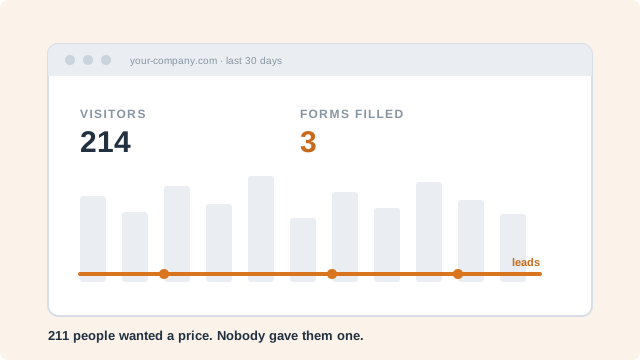
A contractor website analytics view showing 214 visitors and only 3 form submissions, with a flat line of leads under tall bars of traffic

“Should my website be in Spanish too?” The answer depends on two things you can check this week: how many people in your area speak Spanish at home and are more comfortable in it, and whether anyone in your business can deal with a Spanish-speaking customer from the first message to the signed contract. A Spanish page that leads to an English-only phone call is a dead end.

Start with the numbers

The Census Bureau’s report Language Use in the United States: 2019 found that Spanish was “the most spoken non-English language by far,” with 41,757,391 speakers age 5 and over. Of them, 61.4% said they spoke English “very well.” The rest, close to four in ten, said they spoke it “well,” “not well” or “not at all.” Those are the customers a Spanish page helps most. The majority, who speak English very well, can probably use your English site already.

National figures will not tell you about your county. The Census Bureau says the American Community Survey “provides statistics on English usage and language spoken at home for the U.S., states, counties, and selected metropolitan, micropolitan, and other statistical areas.” To look up yours:

  1. On data.census.gov, search for table C16001, “Language Spoken at Home for the Population 5 Years and Over.”
  2. Choose the 5-year estimates. The Census Bureau’s guidance says 1-year estimates cover only areas with populations of 65,000 or more, while 5-year estimates give “Data for all areas.”
  3. Filter to your county, or to each county you serve.
  4. Read three lines: the total; “Spanish”; and under it, “Speak English less than ‘very well’.”

Say your county’s table showed 250,000 people age 5 and over, 40,000 who speak Spanish at home, and 15,000 of those who speak English less than “very well.” (The numbers are made up for the example.) The figure that matters is the 15,000, about 6% of the county: people who would rather read about a furnace replacement, and sign for one, in Spanish. Then check your own records. How many calls and messages came in Spanish last year, and how many of them could nobody handle?

One page, a section, or a second site

There are three sensible sizes, and most small contractors should start with the first.

  • One Spanish page. Your services, the towns you serve, what a typical job costs or what moves the price, your license and insurance, how to reach you and who will answer. The same essentials The Website Pages a Contractor Needs lists for the English site, on one page.
  • A Spanish section. A Spanish version of each main service page. Worth it when the county numbers are large and the Spanish leads you already get turn into jobs.
  • No translation, but a Spanish answer. One line in Spanish on your contact page saying you answer in Spanish, if that is true.

Whichever you pick, translate your real pages rather than writing a thinner Spanish set. Google says localized versions of a page “are only considered duplicates if the main content of the page remains untranslated,” so a fully translated page stands as its own page.

Telling Google about the Spanish page

Google’s guidance on multilingual sites is specific, and most of it is easy to follow:

  • A separate address for each language. “Google recommends using different URLs for each language version of a page rather than using cookies or browser settings to adjust the content language on the page.” A folder such as /es/ is one of the structures Google lists, with the pros “Easy to set up” and “Low maintenance (same host).”
  • One language per page. “Google uses the visible content of your page to determine its language. We don’t use any code-level language information such as lang attributes, or the URL.” Keep each page’s text and menus in one language, and avoid side-by-side translations.
  • No automatic redirects. Google advises against redirecting visitors to another language version “based on what you think the user’s language may be.” Link the two versions to each other and let the visitor choose.
  • hreflang, both ways. An hreflang annotation tells Google the English and Spanish pages are versions of each other. “Each language version must list itself as well as all other language versions,” and “If two pages don’t both point to each other, the tags will be ignored.” The value is a language code with an optional region, such as “es” or “es-US.” Google supports only codes from its two listed standards, and names “es-419” as one it does not support, so skip the Latin American Spanish code.

If your website builder offers a language feature, check that it does these things. One that switches the language on a single address by reading the visitor’s browser settings is the case Google warns about: Google “might not find and crawl all your variations.”

Get the Spanish right

A Spanish page is advertising just as your English pages are, and the FTC’s basic rules for advertisers are short: “Advertising must be truthful and non-deceptive,” and “Advertisers must have evidence to back up their claims.” Two consequences for a contractor:

  • Treat machine translation as a draft. Have a fluent speaker, ideally one who knows the trade’s words, read every line before it goes up. A mistranslated price, warranty or scope line is a promise you did not mean to make.
  • Promise only the Spanish you have. Write “Se habla español” only if a Spanish speaker actually answers. If one person on the crew speaks Spanish, say when that person is available.

AI-Written Website Content covers checking a machine draft for claims you cannot back up.

Answer in the same language

The page is the easy part. A homeowner who reads your Spanish page will write or phone in Spanish, and the reply has to match.

  • Add a language choice to your contact form, so you know before you reply.
  • Decide who answers Spanish messages, and how fast, before the page goes live.
  • Keep a few reviewed replies ready in Spanish: the first answer, the visit confirmation, the note that goes with an estimate.
  • Plan for the estimate and the contract in Spanish too. In some sales the law requires it.

Where the law asks for the same language

For door-to-door sales, the FTC’s Cooling-Off Rule makes it an unfair and deceptive practice not to give the buyer a completed receipt or copy of the contract “in the same language, e.g., Spanish, as that principally used in the oral sales presentation,” and the Notice of Cancellation must be in “the same language, e.g., Spanish, as that used in the contract” (16 CFR 429.1(a) and (b)). The 3-Day Right to Cancel explains when a sale at the customer’s home falls under the rule.

Some states add their own rules. California’s Civil Code §1632(b), for example, requires a business that negotiates primarily in Spanish, Chinese, Tagalog, Vietnamese or Korean to deliver a translation of certain contracts before they are signed. Its list includes consumer loans and extensions of credit and residential leases, so if you arrange financing for customers in California, check whether your paperwork is covered.

The same thinking applies inside the business. If Spanish is the first language on your crew, OSHA’s 2010 training policy statement says that “if an employee does not speak or comprehend English, instruction must be provided in a language the employee can understand”; Safety Training Your Crew Understands covers that side.

A checklist

  1. Pull table C16001 (5-year) for each county you serve, and note the “less than ‘very well’” count under Spanish.
  2. Count last year’s Spanish calls and messages, including the ones nobody could answer.
  3. Name the person who answers in Spanish, and when.
  4. Start with one Spanish page at its own address, linked to and from the English version, with hreflang both ways.
  5. Have a fluent speaker review it, then check it on your own phone with the thumb test.
  6. Read your contract and estimate templates against the language rules above before the first Spanish sale.

General information, not legal or tax advice. Rules change and vary by state; check with the agency named above or a professional for your situation.

Sources

  1. Language Use in the United States: 2019, American Community Survey Reports ACS-50 (August 2022), U.S. Census Bureau (accessed October 22, 2026)
  2. Language Use Data, U.S. Census Bureau (accessed October 22, 2026)
  3. Variables in table C16001, Language Spoken at Home for the Population 5 Years and Over (2020-2024 ACS 5-year), U.S. Census Bureau, Census Data API (accessed October 22, 2026)
  4. Using 1-Year or 5-Year American Community Survey Data, U.S. Census Bureau (accessed October 22, 2026)
  5. Managing multi-regional and multilingual sites, Google Search Central (accessed October 22, 2026)
  6. Tell Google about localized versions of your page, Google Search Central (accessed October 22, 2026)
  7. Advertising FAQ's: A Guide for Small Business, Federal Trade Commission (accessed October 22, 2026)
  8. 16 CFR 429.1, The Rule (Cooling-Off Rule for door-to-door sales), Legal Information Institute, Cornell Law School (text of the federal regulation) (accessed October 22, 2026)
  9. OSHA Training Standards Policy Statement (memorandum, April 28, 2010), Occupational Safety and Health Administration (accessed October 22, 2026)
  10. California Civil Code Section 1632, Translation of contracts, California.Public.Law (text of the California statute) (accessed October 22, 2026)

Where this comes from

Written by the team at Tailgate Office, LLC. Every figure comes from the sources listed above, as of the day each was accessed; prices and rules change without warning. Nothing here is legal, tax or financial advice.

Field Notes by email

One email a week with the week's Field Notes. Unsubscribe in one click. We never sell or share your address.

We email you a link to confirm first. What we keep, and for how long.

Keep reading

A contractor website analytics view showing 214 visitors and only 3 form submissions, with a flat line of leads under tall bars of traffic
Websites

An FAQ Page Built From the Questions Customers Really Ask

An FAQ page earns its place when it answers the questions your phone and inbox already get, with numbers and limits. How to collect them, write answers people trust, decide what goes on the service pages instead, and why Google no longer shows FAQ rich results at all.

A contractor website analytics view showing 214 visitors and only 3 form submissions, with a flat line of leads under tall bars of traffic
Websites

AI Overviews and Local Search: What Changes for Contractors

Google's AI summaries cut clicks on some searches, mostly long questions. What the research found, which of a contractor's searches are affected, what Google says to do, and how to see the effect in Search Console.

A contractor website analytics view showing 214 visitors and only 3 form submissions, with a flat line of leads under tall bars of traffic
Websites

Google Profile Photos and Posts: What Is Worth the Time

Google's own ranking tips mention photos and reviews, not posts. Which photos answer a homeowner's questions, Google's file rules, how long a post stays up, why a phone number can get one removed, and a fifteen-minute monthly routine.

The office your truck never had.

Set it up tonight. It quotes tomorrow's leads, and every missed call you log gets answered from one inbox. Free for 30 days, no card required.