
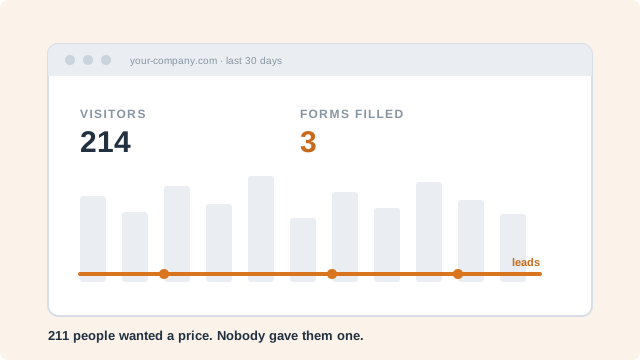
A contractor website analytics view showing 214 visitors and only 3 form submissions, with a flat line of leads under tall bars of traffic

Somebody has probably told you that you need a blog: post twice a week and Google will send you work. The honest answer is narrower. Writing helps when each post answers a question your customers really ask, from what you know from doing the work. It does very little when it is filler written to a schedule, and Google has written rules against the worst of it. And for a search like "plumber near me," your Business Profile matters more than any post.

Where a blog fits, and where it does not

Google's help pages say local results "are mainly based on relevance, distance, and popularity." Distance is how far your business is from the person searching. Prominence, as the same page calls it, is "how well-known a business is," based partly on "how many websites link to your business and how many reviews you have." A blog post does not move your shop closer to anyone, and it does not add a review. For "roofer near me," the work is a complete, accurate profile and a steady flow of honest reviews; the Business Profile setup covers that first.

Where writing does help is the stretch before someone is ready to hire: the questions people type while they are still working out what they need. Why is there water under the water heater? Does a fence need a permit here? What makes one deck cost twice another? A page that answers one of those well can be found by the right person at the right moment, and it shows them you know the work before they ever contact you.

What Google says it rewards

Google publishes the questions it suggests site owners ask about their own pages. A few that fit a contractor's site exactly:

  • "Does the content provide original information, reporting, research, or analysis?"
  • "Does your content clearly demonstrate first-hand expertise and a depth of knowledge (for example, expertise that comes from having actually used a product or service, or visiting a place)?"
  • "After reading your content, will someone leave feeling they've learned enough about a topic to help achieve their goal?"
  • "Does the content have any easily-verified factual errors?"

That is good news for anyone who works with their hands. First-hand experience is the one thing a generic writer cannot fake: what you found when you opened up the wall, which shingle failed on which slope, why you stopped using a product. Google's SEO starter guide says much the same in plainer words: content people find "compelling and useful" will likely influence your site's presence in search "more than any of the other suggestions in this guide," and you should "create the content yourself based on what you know about the topic."

What Google treats as spam

Pages made in bulk to rank rather than to help a reader are what Google's spam policies call "scaled content abuse," however they are written. AI-Written Website Content covers that policy and what it means if you use a writing tool, and Service-Area Pages That Rank Without Spam covers the doorway rule for town pages. Two more points bear directly on a contractor's blog:

  • Keyword stuffing includes, in the policy's words, "blocks of text that list cities and regions that a web page is trying to rank for." A post that closes with a paragraph of town names is exactly that.
  • Packaged posts. Be wary of a service that posts generic articles under your name: Google's own self-check asks whether content is "mass-produced by or outsourced to a large number of creators, or spread across a large network of sites."

Three myths Google has answered

  • "Posts need 1,500 words." Google lists writing to a word count as a warning sign and answers its own question: does Google have a preferred word count? "(No, we don't.)" A post is as long as the answer.
  • "Post often so the site looks fresh." Google warns against "producing lots of content on many different topics in hopes that some of it might perform well," and against adding or removing content to make a site seem "fresh": "(No, it won't)." Changing the date on an old post without changing it is on the same list.
  • "You will see results next week." Google's starter guide says some changes take effect "in a few hours, others could take several months," and suggests waiting a few weeks before judging whether a change helped.

What to write about

The best list of topics is already in your phone: the questions customers asked this month. Each one that comes up more than once is a post. Some kinds that work for most trades:

  • What drives the price of your most common job: the measurements, materials and site conditions that move it, in the words you use on a sales visit.
  • A finished job, explained. What the problem was, what you found, what you did and why, with photos taken with the customer's permission (before and after photos covers what not to show).
  • How the process works where you work: the permit, the inspection, how long each takes, what the homeowner needs to do. Only what you have checked with the office that issues it.
  • Season by season: what to check before the first freeze or the first heat wave, and what can wait.
  • "Should I repair or replace?" for the thing you fix most, with the honest answer for each case.

Say a gutter installer hears "do gutter guards actually work?" three times in one week. One evening's writing, from what he has seen on real roofs (which guard types clog, which hold up under the trees in his area, when guards are not worth it), makes a page he can also send the next customer who asks. That is the test for every post: would you send the link to a customer?

A pace you can keep

One good post a month, written by the person who does the work, beats a weekly post nobody would send to a customer. Keep a running list of questions from calls and visits, write the one you heard most, and read it back the next morning for anything wrong. Google's starter guide also asks you to keep what you have published current: "update it as needed, or even delete it if it's not relevant anymore." A price post with three-year-old numbers can do more harm than no post at all.

Put your name and your trade on the posts. Google says its systems look for factors that show what it calls E-E-A-T (experience, expertise, authoritativeness and trustworthiness), and that "something that helps people intuitively understand the E-E-A-T of content is when it's clear who created it." And when a post quotes a rule, a fee or a figure, name where it came from, the way this article lists its sources at the end. More on the website side of the business is in Field Notes.

Posts about cost raise the reader's next question: what would mine cost? NapkinPrice™ puts an instant price range on your own website, so a reader who arrives from a post can get a number without waiting for a reply.

Sources

  1. Creating helpful, reliable, people-first content, Google Search Central (accessed October 22, 2026)
  2. Spam policies for Google web search, Google Search Central (accessed October 22, 2026)
  3. Google Search Essentials, Google Search Central (accessed October 22, 2026)
  4. Search Engine Optimization (SEO) Starter Guide, Google Search Central (accessed October 22, 2026)
  5. Tips to improve your local ranking on Google, Google Business Profile Help (accessed October 22, 2026)

Where this comes from

Written by the team at Tailgate Office, LLC. Every figure comes from the sources listed above, as of the day each was accessed; prices and rules change without warning. Nothing here is legal, tax or financial advice.

Field Notes by email

One email a week with the week's Field Notes. Unsubscribe in one click. We never sell or share your address.

We email you a link to confirm first. What we keep, and for how long.

Keep reading

A contractor website analytics view showing 214 visitors and only 3 form submissions, with a flat line of leads under tall bars of traffic
Websites

An FAQ Page Built From the Questions Customers Really Ask

An FAQ page earns its place when it answers the questions your phone and inbox already get, with numbers and limits. How to collect them, write answers people trust, decide what goes on the service pages instead, and why Google no longer shows FAQ rich results at all.

A contractor website analytics view showing 214 visitors and only 3 form submissions, with a flat line of leads under tall bars of traffic
Websites

AI Overviews and Local Search: What Changes for Contractors

Google's AI summaries cut clicks on some searches, mostly long questions. What the research found, which of a contractor's searches are affected, what Google says to do, and how to see the effect in Search Console.

A contractor website analytics view showing 214 visitors and only 3 form submissions, with a flat line of leads under tall bars of traffic
Websites

Google Profile Photos and Posts: What Is Worth the Time

Google's own ranking tips mention photos and reviews, not posts. Which photos answer a homeowner's questions, Google's file rules, how long a post stays up, why a phone number can get one removed, and a fifteen-minute monthly routine.

The office your truck never had.

Set it up tonight. It quotes tomorrow's leads, and every missed call you log gets answered from one inbox. Free for 30 days, no card required.