
“Do I have to list the pay in my help-wanted ad?” In at least ten states, yes, and in two of them the rule starts with the very first employee. Several also want the benefits, and Colorado wants the application deadline too. The laws reach further than job boards: a printed flyer, a social media post or a sign can be a posting. Here are the ten we checked against their statutes on October 20, 2026, what each law asks for, and an ad for a crew position that meets the strictest of them.
Ten states side by side
| State | Who must comply | The posting must show |
|---|---|---|
| Colorado (C.R.S. §8-5-201; POST Rule 11) | Any employer with a person employed in the state | Pay or range; bonuses and other pay; benefits; deadline to apply; how to apply |
| Maryland (Lab. & Empl. §3-304.2) | Any size; the state’s FAQ even covers household employers | Wage range; benefits and any other pay |
| New York (Labor Law §194-b) | 4 or more employees | Pay or range; the job description, if one exists |
| Vermont (21 V.S.A. §495p) | 5 or more employees | Pay or range |
| New Jersey (P.L.2024, c.91) | 10 or more employees over 20 calendar weeks | Pay or range; benefits and other pay programs |
| California (Labor Code §432.3) | 15 or more employees | Pay scale |
| Illinois (820 ILCS 112/10) | 15 or more employees | Pay scale and benefits (a link to a public page counts) |
| Washington (RCW 49.58.110) | 15 or more employees | Wage scale or salary range (or the fixed wage); benefits and other pay |
| Massachusetts (G.L. c.149 §105F) | 25 or more employees in the state | Pay range |
| Minnesota (Minn. Stat. §181.173) | 30 or more employees in the state | Starting salary range (or a fixed rate); benefits and other pay |
Three notes on that table. It may not be complete, so check your own state’s labor department if it is not listed. Several of these laws turn on where the job is done (New York, Illinois, Maryland and Vermont say so in their text), so a contractor based next door who hires for work across the line should read that state’s law too. And cities can add their own: New York’s statute says it does not override local laws, and the state labor department points to New York City’s separate pay transparency law.
What counts as a posting
Washington and Minnesota use nearly the same definition: a posting is any solicitation meant to recruit applicants for a specific available position, done by you or through a third party, “electronically or via printed hard copy,” that includes qualifications for the applicants you want. New York’s “advertise” means making a written description of a job available to a pool of potential applicants, “including electronically.” Maryland’s labor department lists newspaper ads, printed flyers, social media posts and emails sent to more than one applicant.
Two points matter most for a trade business:
What a lawful range looks like
Honest at both ends. California defines the pay scale as “a good faith estimate of the salary or hourly wage range that the employer reasonably expects to pay for the position upon hire.” New York and Maryland want the minimum and the maximum. Minnesota says it outright: “A salary range may not be open ended,” so “$20 and up” or “up to $30” does not work there.
Built from real numbers. Maryland’s FAQ says a good-faith range may draw on your pay scale, a range you already set for the job, what current employees in comparable jobs are paid, or the amount you budgeted. For a small crew, that usually means what you pay the people already doing the work.
Room to move. Colorado’s rule says you may pay more or less than the posted range if it was your good-faith, reasonable estimate when you posted it, and Vermont’s law allows hiring outside the range for reasons such as an applicant’s qualifications or labor market factors.
Benefits in plain words. Colorado’s rule lists what the benefits description covers: health care, retirement, paid days off including sick leave, and other benefits reported for federal tax purposes, but not minor perks. Describe what you actually offer.
A sample ad for a crew position
Say a roofing company with 18 employees in Colorado is hiring an installer. An ad that would also meet the other nine states’ lists reads like this, with your own numbers in it:
Roofing Installer, full time. Tear off and install asphalt shingle roofs on homes in [county]. You need a valid driver’s license and to be able to work on pitched roofs all day. Pay: $22 to $28 an hour, depending on experience. Other pay: [any bonus, and how it is earned]. Benefits: [paid days off, sick leave, health or retirement plans you offer]. Apply by: [date], or “applications accepted on an ongoing basis.” How to apply: [link, address or QR code].
Each labeled line answers one of the laws above, and the short job description covers New York’s. The figures are an illustration; your range has to be the one you would actually pay.
What getting it wrong costs
The habit that covers you
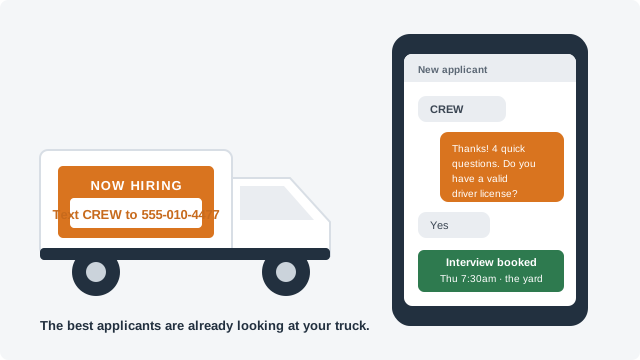
Keep one ad template with the range, the other pay, the benefits, the deadline line and how to apply, and use it everywhere: the job board, the social post, the flyer at the supply house. If you hire off signs, either print the range on the sign or make sure the web address or QR code on it leads to a page that shows it. CrewFunnel™ is built around that kind of sign: today its printed Now Hiring sign carries a QR code that opens your screening questions in the applicant’s browser, so put the pay and benefits where an applicant can read them before they answer. And when someone says yes, the paperwork for a new hire starts on day one.
General information, not legal or tax advice. Rules change and vary by state; check with the agency named above or a professional for your situation.